Value of Coaching
News & Insights
7 Min Read
Coaching creates value beyond the playing field, contributing to wellbeing, personal development, social connection and stronger communities. Yet much of this impact, particularly the contribution of volunteer coaches, remains overlooked. Drawing on examples from community rugby in England and South Africa, this article explores how Social Return on Investment (SROI) and Theory of Change approaches can help organisations measure coaching outcomes. It highlights how Experienz connects fragmented data to demonstrate social impact, strengthen sponsor relationships and build an evidence-based case for continued investment in sport and communities.

The value of sport is rarely measured by the enormous contribution of coaches. We measure participation. We measure audiences. We measure sponsorship. We measure ticket sales, media exposure, and commercial returns.
But what about the value created by the people who make participation possible in the first place?
That is where the conversation around the social value of coaching becomes interesting.
The value we can see and the value we cannot
Sport is often described as a vehicle for change. But the value it creates extends well beyond what happens during a match. A sporting programme can contribute to physical and mental wellbeing, social connection, confidence, skills development, education, employment and stronger communities. The challenge is that many of these outcomes are less visible than a ticket sale or a sponsorship impression. Coaches sit at the centre of many of these outcomes. They are the people delivering sessions while creating environments where people can develop. In grassroots sport, many of them are volunteers. That creates an interesting question:
If coaches are helping create these outcomes every week, what is the value of that contribution?
It is a question worth asking because the scale can be significant.
Research from the Rugby Football Union found that community rugby in England generated an estimated £2.03 billion in social value during the 2023/24 season, involving approximately 378,000 players and 89,000 volunteers. More than £707 million was associated with improved physical and mental health, while £823 million was attributed to social and community value. The research also identified more than 24 million volunteer hours across the game. Those numbers tell us something important. The value of sport is much larger than the commercial activity we traditionally associate with it, and volunteering is a significant part of that value.

The invisible economy of coaching
Volunteering is one of the clearest examples of value that can easily go unnoticed. A volunteer coach might give up several hours every week to run training sessions, travel to fixtures, organise teams and support players. They may not receive a salary, but their contribution still creates economic and social value through the skills, qualifications and experience they bring to the role.
From Coach to Community
Consider a coach working in an area where participation opportunities are limited. They might work with 20 or 30 young people each week. Some will become regular participants. Some will develop new skills. For some, that experience might lead to further education or employment. For others, it might simply mean staying active and improving their wellbeing. A few may even go on to become coaches themselves.
So what is the true value of coaching?

The answer lies in understanding the theory of change behind coaching: how the time, skills, and relationships invested by a coach can create a chain of outcomes that extends well beyond the training session itself.
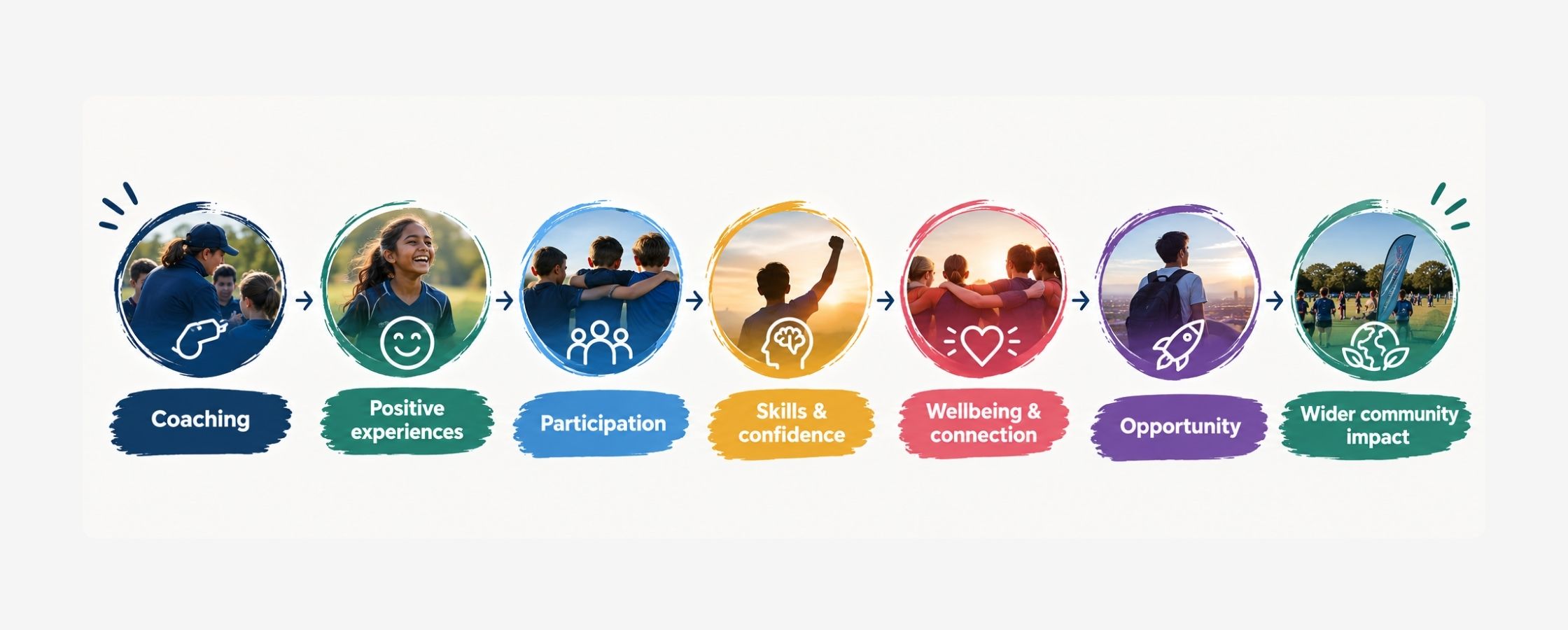
The difficulty is that the data needed to understand this theory of change is often fragmented, providing only snapshots of the wider picture. Participation data might sit with a governing body. Volunteer information might sit with a club. Surveys might be held by a programme provider. Sponsorship data might sit within a commercial team. Each dataset tells part of the story. Very few bring those different pieces together to show the full picture.
This is where Experienz can change the conversation.
Measuring the ripple effect
What if, instead of simply measuring coaching activity, we measured the pathway it creates and then looked at the ripple effect that follows?
The question is not whether every coaching session should be assigned a monetary value. It is whether organisations can become better at understanding the outcomes that coaching helps create.
What happens to participation over time? Who is being reached, and which communities are benefiting? How many volunteer hours are being contributed? Are participants developing new skills, becoming more engaged with education or staying active? Are new pathways into coaching, volunteering or employment being created? And perhaps most importantly, what is the wider value of all of this to the community?
These are not simple questions, and there is no single number that can answer them all. But established methodologies, including Social Return on Investment (SROI) and Theory of Change approaches, demonstrate that it is possible to move beyond simply counting activity and towards understanding the outcomes and wider value that activity creates.
The RFU's social value assessment is one example. Its research mapped outcomes across participation, volunteering, health and wellbeing, community and economic activity to build a broader picture of rugby's contribution. The Tyneside coaching research provides another.
Together, they point towards a bigger opportunity: understanding not only the value of sport, but the value created by the people delivering it.
In South Africa, for example, SA Rugby's Get Into Rugby programme gave 244,788 boys and girls the opportunity to play across all nine provinces in 2023. The programme also created opportunities for aspiring male and female coaches to develop their coaching skills. The scale of programmes such as this raises an interesting question.

Image source: MSCSports
When thousands of young people are introduced to organised sport, the value of participation is clear. But behind that participation is a network of people and organisations making it possible. Coaches are developing skills and building relationships. Volunteers are giving their time. Communities are providing facilities and support. Organisations are investing resources.
So how much value is being created across this entire pathway and how much of that value can we actually evidence?
The answer will look different from country to country and from sport to sport. But the principle remains the same: if sport is being used as a vehicle for social change, we need to get better at measuring the change.
Proving Value
For sports organisations, this has implications beyond reporting. Being able to demonstrate social value can change how a sport communicates with sponsors, partners, funders and government. A sponsor may already know how many people saw its branding. A rights holder may know how many people attended an event. A federation may know how many registered players it has.
But what if it could also demonstrate the wider outcomes generated through the sport it supports?
That creates a different conversation.
It moves from:
“We reached 10,000 people.”
to:
“Here is what happened because those 10,000 people participated.”
That distinction matters, and it's where the commercial opportunity sits. A federation that can evidence outcomes, not just reach, has a stronger case for renewal and a higher-value proposition for sponsors. A sponsor that can point to real, measured social impact, not just impressions, has a stronger story to tell its own stakeholders. Mapping the coaching pathway is what turns participation numbers into a case for continued and increased investment.
This is where better data and evidence can play a decisive role, and it's exactly where Experienz operates. Our work is centred on connecting fragmented information to answer the questions that matter, turning existing data into evidence that supports commercial, investment and board-level decisions. The same principle applies directly to social value in sport.
Sports organisations already hold enormous amounts of information: participation data, audience research, programme evaluations, partner reports, surveys and other research. Each contains a piece of the story. The opportunity and where Experienz adds value, is in connecting those pieces into a single, evidenced pathway.
For coaching, that means building a clear picture of the relationship between investment, participation and outcomes. It can help a federation understand the true contribution of its coaching network. It can help a sponsor see the wider value created through the programmes it funds. And it can help organisations build a stronger, evidence-backed case for continued and expanded investment in the communities they serve, unlocking commercial revenue by proving impact sponsors can actually stand behind.
If sport is a vehicle for change, perhaps it's time we started measuring the people driving it. That's the work Experienz is built to do.
Team Experienz
Contact Experienz
Similar Topic