Why Social Return on Investment (SROI) is a Key Measurement in Sport Sponsorship
News & Insights
7 Min Read
Social Return on Investment (SROI) is reshaping sport sponsorship by helping brands measure the social, environmental and economic value their partnerships create. By translating outcomes such as wellbeing, education, inclusion and community development into measurable value, SROI enables sponsors to demonstrate impact beyond traditional exposure metrics, strengthen accountability and build more credible, purpose-driven partnerships that deliver meaningful benefits for both communities and businesses.

In today’s sponsorship landscape, the demand is more than brand exposure; real social impact is finding its way into the marketing mix. Social Return on Investment (SROI) is a way to quantify the community and environmental value of a sponsorship in monetary terms. Unlike traditional ROI, which focuses on financial or marketing metrics, SROI translates outcomes like improved well-being, education or community cohesion into a common “currency.” As Ohio University notes, SROI “empowers organizations… to assess their full contribution: social, environmental and economic”, turning intangible results into concrete figures. In practice, this means sponsorship teams can show how every pound invested creates social value, bridging the gap between marketing goals and real-world benefits.
Why Social Impact Ranks Second (and Why Brands Are Shifting Gears)
Trust, loyalty, credibility, and social impact are key drivers of brand equity. As consumers now have greater access to insights and data through AI, brands need to work harder to aggregate and demonstrate a broader range of value to increasingly ethical consumers. Industry data shows that social impact has risen to become the second-highest priority for brands when investing in sponsorships. One major driver is the rise of the conscious consumer. Audiences today increasingly expect the brands they support to stand for something beyond profit, with purpose and values playing a growing role in purchasing decisions. At the same time, brands are operating in an increasingly crowded and noisy market, where consumers are exposed to thousands of marketing messages every day. Purpose-driven sponsorship offers an opportunity to cut through this noise by creating genuine emotional connections that traditional advertising often struggles to achieve. There is also growing pressure from boards, investors and wider stakeholders to demonstrate progress against Environmental, Social and Governance (ESG) commitments. By aligning with meaningful social initiatives through sport, brands can create tangible community impact while demonstrating that their sponsorship investment contributes to wider business and societal objectives.
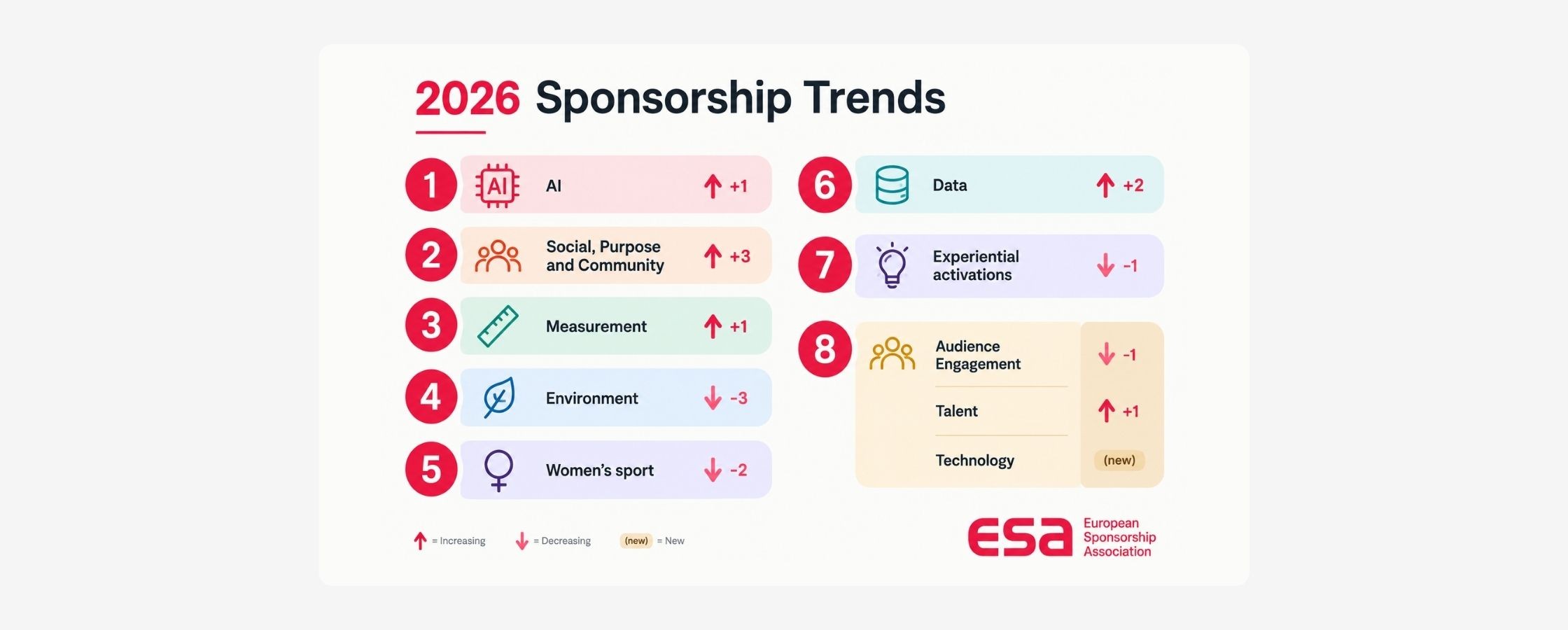
Image source: sponsorship.org
Measuring SROI in sponsorship is crucial because it quantifies the impact that traditional metrics can overlook. For brands, this evidence can also serve as a powerful commercial differentiator. A sponsorship proposal supported by credible impact data can demonstrate value beyond traditional exposure metrics, while measurable results can strengthen the case for renewal and help build longer-term partnerships.
Sport changes lives, and many organisations invest in grassroots sport, education programmes and community events with the expectation of generating broader social benefits. Yet intangible outcomes such as well-being, empowerment and breaking cycles of generational poverty often fall outside traditional KPIs. SROI helps to fill this gap by engaging all relevant stakeholders, from sponsors and beneficiaries to wider communities, to identify and value the outcomes that matter. Crucially, Experienz uses data-driven analysis to translate these outcomes into a familiar format: the $ or £ invested. In effect, it provides sponsorship teams with a “universal language” for communicating social change, enabling boards and sponsors to assess social return alongside ticket sales, media reach and other traditional metrics. This allows the full value of a sponsorship to be captured, highlighting its contribution across the wider marketing mix.
Sport as a Vehicle for Change: The Evolution of Sponsorship Impact
Sport has always been more than just a game; it is a universal language and a powerful vehicle for change. It goes far beyond traditional corporate charity donations. Today, it is about creating measurable, lasting improvements in people’s lives, from making spaces more inclusive and supporting mental and physical wellbeing, to opening up educational opportunities and protecting local environments. Fans feel a deep emotional loyalty to their teams and the sports they follow. When a brand integrates itself into that world, it has the opportunity to build on that trust. Sponsorship can therefore act as a bridge between commercial investment and meaningful societal progress.
Where It Works and Where It Falls Flat
Social impact sponsorship is not a magic wand. Its success depends on whether the initiative is genuinely aligned with a brand’s values, objectives and wider strategy. It works best when the connection feels natural and credible.
A compelling example is ADvTECH’s three-year partnership with Cricket South Africa (CSA). The partnership positions ADvTECH as the official sponsor of the National U13, U16 and U19 Boys’ and Girls’ Youth Weeks and Women’s Test Cricket, as well as an associate partner of Men’s Test Cricket. More importantly, the partnership is designed to connect cricket with education and youth development, with ADvTECH investing in young players and supporting the development of future talent. In 2025, the U16 and U19 Youth Weeks involved 850 players across all nine provinces and more than 350 matches, while the partnership also includes plans to strengthen the pathway for girls’ cricket through specialised programmes at selected schools.
This makes the partnership more than a traditional sponsorship. ADvTECH is using a sport that already has deep cultural relevance in South Africa to reinforce its own position within education and youth development. The social impact is therefore closely connected to the brand’s core purpose, creating value for young athletes and communities while strengthening the brand’s relevance with its audiences.

Image source: groupadvtech.com
However, social impact sponsorship can quickly fall flat when it is treated simply as a marketing tactic or a box-ticking exercise. This is where purpose-washing becomes a risk. If a company with a poor environmental record places its logo on a sustainability initiative without addressing its own environmental practices, audiences are increasingly likely to question its credibility.
The lesson is simple: social impact cannot be bolted on to a sponsorship; it needs to be built into the strategy from the outset and backed by genuine action. And Experienz offers insights to build meaningful strategy.
The days of brands simply saying they are doing good are over. With access to increasingly sophisticated data and SROI frameworks, consumers and stakeholders can scrutinise these claims and hold brands accountable. Did that grassroots partnership genuinely improve local well-being? Did it create meaningful, measurable change? By using data to turn good intentions into verifiable evidence, brands can move beyond empty slogans and demonstrate the real value of their social impact.
Why SROI Is a Game-Changer for Modern Partnerships
Transparency and accountability, allows sponsors and stakeholders to see not just what was invested, but what that investment helped achieve.
It can also provide evidence of how a partnership has contributed to wider social and environmental objectives, while informing future decision-making. Rather than relying solely on assumptions or anecdotal success stories, organisations can use robust evidence to understand which initiatives are generating meaningful outcomes and where investment can have the greatest impact.
In an increasingly purpose-driven sponsorship landscape, being able to prove the impact of an investment is becoming just as important as being able to prove its reach. Quantifying social benefits builds accountability and opens doors to new funding, much like UEFA’s amateur football model, which used SROI data to help secure government funding and demonstrate to private-sector investors that there was a clear social return on their investment. In Scotland, SROI evidence helped the Scottish Football Association secure a three-year £150,000 grant from the National Lottery Fund, alongside £4 million in funding from the national agency of sport. At a local level, Aberdeen FC Community Trust used the evidence to secure a £250,000 annual grant from local authorities, while its reported 1:10 social return also gave private-sector investors greater confidence that their funding was delivering meaningful social outcomes.

Image source: scottishfa.co.uk
Here at Experienz, we not only provide clear evidence of how SROI insights translate into marketing and commercial objectives, but also bring sponsorship and SROI metrics together as a single source of truth. This helps businesses define, refine and strengthen their sponsorship strategy. That means every proposal or renewal can tell the full story: the audience reached and the social good achieved. Measuring SROI is now essential for sponsors to demonstrate that their investment genuinely matters.
Team Experienz
Contact Experienz
Similar Topic